

Exploring the function and creative potential of dreams…
A couple of months ago I had a truly extraordinary dream that motivated me to research the phenomenon of dreams from a serious scientific perspective. I can easily say this was the most empowering dream of my life—till now. It seemed like a complete work of art, with imagery and symbolism unforgettably strong and clear.
The dream opened in a venue that was part-luxury hotel, part-train station. It was crowded. The ceiling was high, and there were some classical pillars around. I was in this place. There wasn’t anybody here who was familiar to me. I soon found myself next to a strange figure—pale like a vampire. He looked sick, and did not resemble anybody whom I knew, real or fictional. There was an awareness in the dream that the sickness he exhibited was more mental than physical.
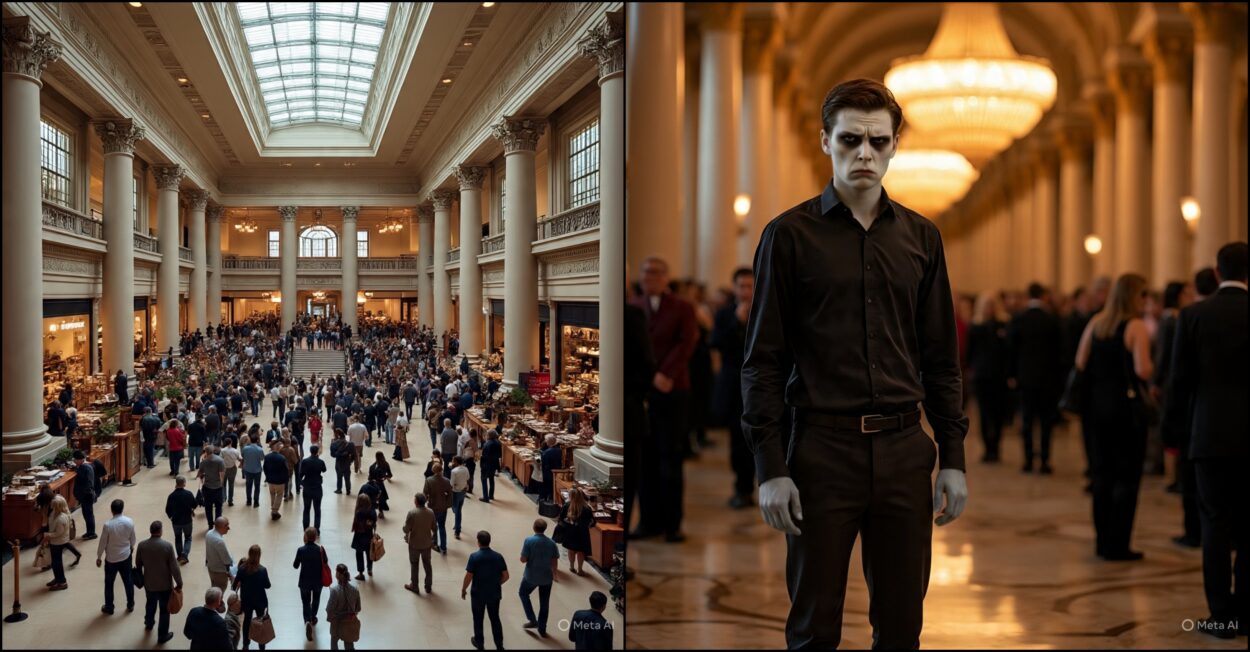
AI impressions of the venue and the pale, sickly figure in my dream…
The figure tried to make small talk with me, and I wondered if he could help me, but nothing that he said made any sense to me. Suddenly there was a gunshot sound, and the figure vanished. I found the disappearing act cowardly and silly, and was happy he was gone as he was of no use. Then I discovered that I wasn’t holding onto my bag, but somebody else’s. My own sling bag had been lost. I immediately dropped the bag that didn’t belong to me.
There was too much noise. I could not make connections. I could not have conversations. Instead of leaning in to the chaos, I decided to step back. For a moment, I wondered what to do. Then I simply looked towards the exit and began walking towards it. I passed the glass doors. I kept walking. Soon I was flying outside, having developed wings. I was a solo airplane. I moved farther in the sky, utterly liberated—and then I opened my eyes…
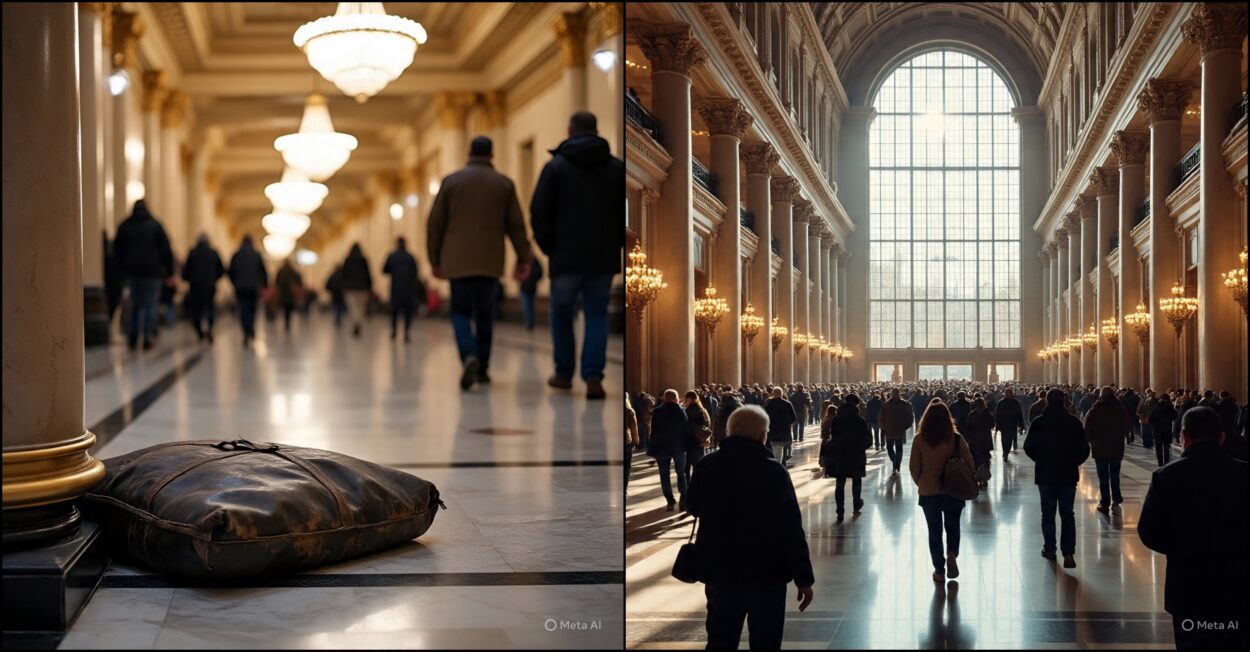
AI impressions of the baggage (not belonging to me) that I dropped, and the exit that I walked past in my dream…

An AI impression of the manner in which I found myself flying solo in the sky once outside the venue in my dream…
I distilled the message of the dream as: (1). Disengage (from those who are not mentally sound), (2). Drop (other people’s baggage), (3). Avoid (places where you don’t belong), (4). Focus (on the way out), (5). Exit and (6). Soar. The most outstanding thing about the dream was that there was no physical struggle in it. It was easy to leave the place and people unsuitable for me. I just had to decide. If there was resistance, it was mostly internal. I loved how this guidance was applicable to all of my life—and didn’t seem limited to an age or phase or season.
Amazed by this simple yet significant—and very creative—dream, I wanted to know if I could have more of such experiences, and also if arts professionals could reap the benefits of these intentionally. I picked up Why We Sleep: The New Science of Sleep and Dreams (2017) by Matthew Walker, a British professor of neuroscience and psychology at University of California, Berkeley. Walker explores how our understanding and interpretation of REM sleep dreaming has changed through history. The ancient Egyptians believed dreams were of divine origin, Aristotle found their source in recent waking events, Freud attributed them to repressed wishes—which would, via a censor in the mind, be divided into “manifest content” and “latent content”. Walker maintains that the Freudian theory, although useful, isn’t enough, and recent brain research has given us more precious perspectives.
Dreams are, the author writes, a mechanism of creative problem-solving whereby we are able to examine the events of human life without their emotional charge. But what about frequent frightening nightmares? In such cases, the individual most likely has prior PTSD and dreaming can be restored to its positive function through medication.
Dreaming also helps us make associations that may escape us during waking life. We’re calmer, and can decode the residue of the day in an inventive way (for instance, Russian chemist Dmitri Mendeleev saw the puzzle of the periodic table arranged in a dream). “Lucid dreaming”, which occurs when one is aware of the fact that they are dreaming, and may gain some volitional control over the process, is especially important in the discussion on the creative potential of dreaming. Walker writes that “it is possible that lucid dreamers represent the next iteration in Homo sapiens’ evolution. Will these individuals be preferentially selected for in the future, in part on the basis of this unusual dreaming ability—one that may allow them to turn the creative problem-solving spotlight of dreaming on the waking challenges faced by themselves or the human race, and advantageously harness its power more deliberately?”
What is the first step that we must take if we want to harness this power? I believe it would be to navigate dream amnesia. During REM sleep, the brain’s chemical environment is different from wakefulness. Lower levels of norepinephrine, a neurotransmitter important for memory encoding, make it harder to retain dream memories. Sometimes, faint imagery remains the moment we wake up but fades within seconds. A bedside notebook that can enable us to make quick notes will be helpful. We can record a few sentences when the visuals, narrative and characters are still sticking to our mind. These may be expanded later systematically in a special dream journal. “Wander” by New York-based design house Baronfig is a good example, wherein the dreamer is prompted to “recall”, “visualise” and “interpret” the dream.

A dream journal published by Baronfig (New York) with headings “Recall”, “Visualize” and “Interpret”.
Additionally, the dreamer can track other aspects of the dream—emotion, sleep quality, time (past, present, future), colour, viewpoint (first person, third person) and type (recurring, lucid, mundane, fantasy, nightmare).
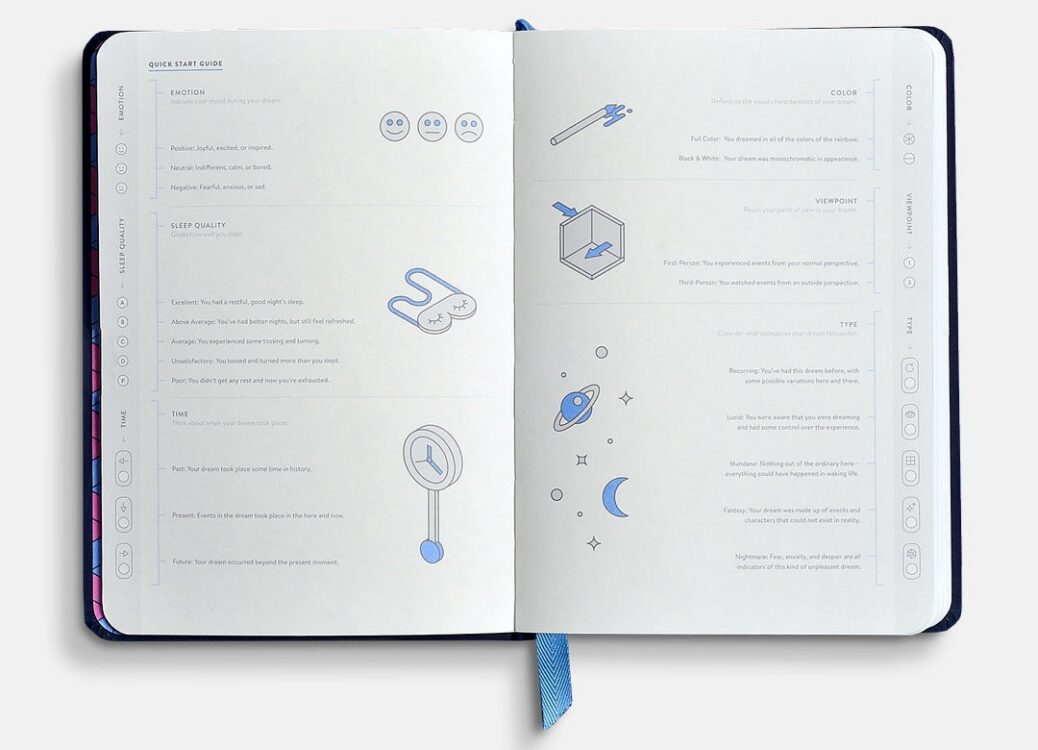
Pages for dream analysis in the “Wander” journal.
Such regular exercises can bring us closer to unravelling and preserving the essence of an exceptional dream—should we be fortunate enough to ever have one.
“Dream incubation” , through which we can induce specific dreams by consciously focusing on a desired topic right before sleep, is another technique worth pursuing. Harvard professor Deidre Barrett presents six steps in the process:
(i). Write down the problem or question and place this by the bed. Be clear, specific, and brief.
(ii). Review the problem or question for a few minutes just before going to bed.
(iii). Once in bed, visualise the problem as a concrete image. For instance, if you are experiencing a sense of isolation, imagine yourself alone in a house, looking out a window wearing a sad face.
(iv). Tell yourself you want to dream about the problem just as you are drifting off to sleep.
(v). Keep a pen and paper—perhaps also a flashlight with a red lens or pen with a lit tip—on the night table. I use a small Dictaphone.
(vi). Upon awakening, lie quietly before getting out of bed. Note whether there is any trace of a recalled dream and invite more of the dream to return if possible. Write it down.
The transitional state where we go from wakefulness to sleep (hypnagogia) is when our subconscious is most susceptible to suggestion. By impressing the right instructions on the mind at this critical interval we can, to an extent, artistically direct the course and content of our dreams.
Article by Tulika Bahadur